Tomoyasu
Bullet TrainTomoyasu is a schoolboy living under the Prince’s rule, where fear and punishment have taught classmates to obey rather than resist. The Prince first selects him as the subject of a dangerous test with a Prototype defibrillator, then makes Takeshi, Tomoyasu’s lifelong companion, the substitute. Tomoyasu’s predicament exposes the cost of the Prince’s control: he is coerced into helping endanger the being he loves, even as the dog’s loyalty preserves a bond the Prince wants to destroy.
Identity and Place in the School
Tomoyasu belongs to the group of students whose conduct is governed by the Prince. One classmate describes him as slow-moving and recalls that he nearly fell behind during a group shoplifting attempt. When a clerk caught up with him, the other students returned and knocked the clerk down so Tomoyasu could get away. They continued attacking the clerk after he was down. The account places Tomoyasu within a group capable of collective violence, but it does not establish that he led or directed it; in later scenes he is instead the person the Prince singles out for punishment.
Tomoyasu is also known among his classmates for saying that his father has intimidating friends. The story gives this as something Tomoyasu says, not as independently confirmed information. The detail matters to the school group because the Prince uses it as a reason to target him, transforming a claim about family connections into leverage over a vulnerable student.
The Prince’s Test
The Prince initially intends to use Tomoyasu as the subject of an experiment with a Prototype defibrillator. Unlike an ordinary AED, the device is a stronger prototype that could conceivably kill someone whose heart is still functioning. The Prince knows the danger but provides the other students with only limited information. His command is therefore not an informed proposal to the group: it conceals the risk while placing Tomoyasu in immediate danger.
Tomoyasu does not agree to take part. In the park, he cries, begs the Prince to spare him, and kisses the Prince’s shoes. The Prince agrees to spare Tomoyasu only on the condition that he bring Takeshi instead. The apparent reprieve does not end the coercion; it transfers its burden onto the dog and forces Tomoyasu to participate in exposing his companion to the test.
The Prince’s aim extends beyond trying the device. Once Tomoyasu’s distress makes him abandon the original plan, the Prince becomes interested in what sacrificing Takeshi will do to Tomoyasu. He sees the dog as the point at which he might sever a relationship that has lasted since Tomoyasu was a small child. The experiment thus serves both as a threat of physical harm and as an attempt to make Tomoyasu betray a deeply valued attachment.
Tomoyasu and Takeshi
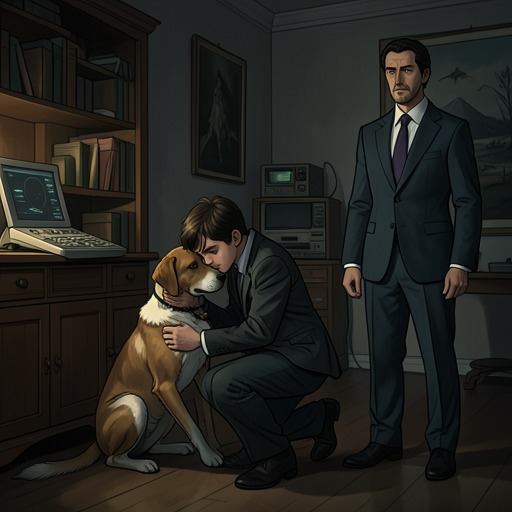
Tomoyasu has had Takeshi for his whole life and is described by a classmate as loving the dog. When the students prepare the experiment, Tomoyasu tries to reassure Takeshi while the two are restrained together. The scene gives his care a concrete form: even under threat, he turns his attention toward calming the dog. His tenderness does not make him free to refuse, but it clarifies what the Prince has made him choose between—his own safety and the protection of a companion who depends on him.
At the same time, the narrative does not present Tomoyasu’s response as uncomplicated heroism. Kimura considers that Tomoyasu is prepared to expose Takeshi to pain and suffering, despite loving him. That contradiction points to the pressure of the situation: Tomoyasu is trying to live with a choice imposed by the Prince, and Kimura recognizes that he may be reaching for a justification that allows him not to see himself as a bad person. The episode shows the coercion’s moral effect as well as its immediate danger, without suggesting that Tomoyasu freely chose the test.
When the Prince’s attention shifts to Kimura, Tomoyasu gets back to his feet. His legs are shaking, but he stands beside Takeshi rather than leaving. Takeshi stays with him and barks toward the Prince. The Prince thinks that only a little more pain or betrayal would be needed to shatter their bond, but the visible moment has not achieved that result: the dog remains loyal, and Tomoyasu remains with him.
Fear, Helplessness, and Narrative Significance
Kimura understands the school’s obedience through the idea of learned helplessness. He recalls guarding a kidnapped man who was neither tied up nor locked in, yet did not try to leave. A fellow guard explained the concept through an experiment in which a dog, after experiencing shocks it could not avoid, stopped trying to escape even when a later action could prevent the shock. Kimura applies this account to the students, who have repeatedly witnessed suffering at the Prince’s hands and have come to believe that resistance is futile. The electric shocks are part of the larger atmosphere of control, though Kimura does not know precisely how they are administered or what orders the Prince gives.
Tomoyasu’s submission to the test takes place within this system, not apart from it. His pleading and compliance follow the Prince’s threat to spare him only if he supplies Takeshi; the conditions leave him under pressure whichever way he turns. The preparations also reveal how the Prince’s authority damages trust among the students. One student challenges another for showing reluctance and threatens to report him, while that student denies hesitating. The group’s attention is divided between the person being endangered and the risk of incurring the Prince’s displeasure.
Tomoyasu therefore occupies two positions in the school’s violence: he has been part of a group that harmed a clerk, and he becomes a target whom that same culture of fear leaves unable to protect his dog. The contrast makes the scene more than a simple division between aggressors and victims. Under the Prince’s rule, students may participate in harm while remaining vulnerable to its next command. Against this manufactured mistrust, Tomoyasu’s bond with Takeshi offers a fragile counterpoint—not proof that the Prince’s power has ended, but evidence that his effort to make betrayal complete has not yet succeeded.